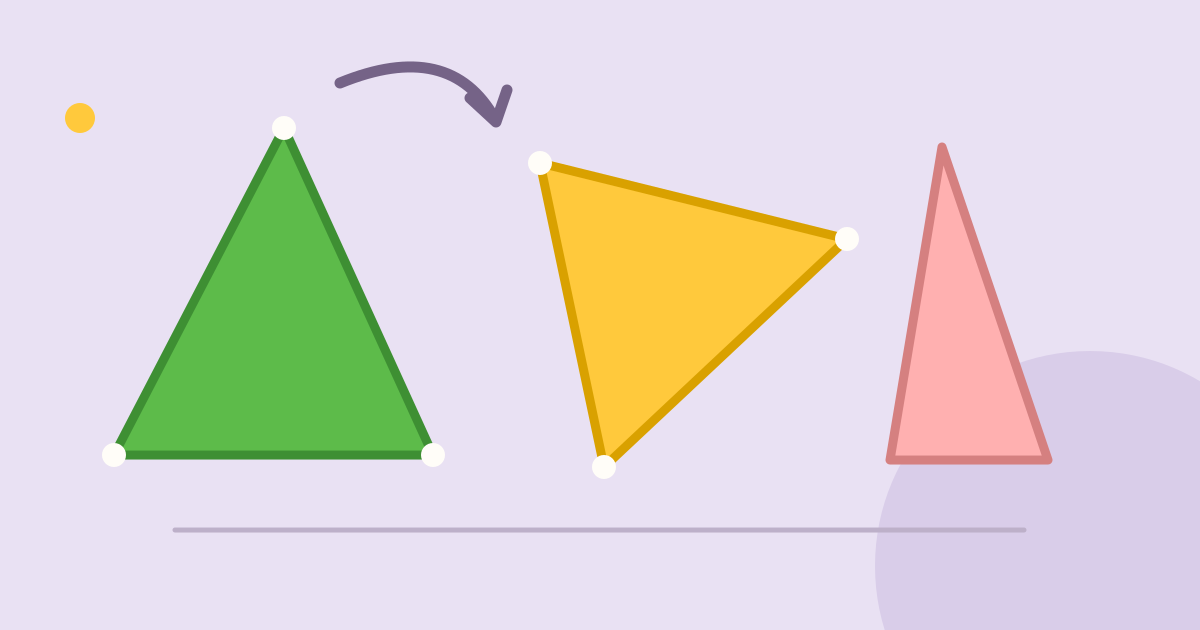
Draw a triangle with its point at the top. Now turn the paper sideways. If your child gives it a new name, you have something interesting to explore together: what changes when a shape turns, and what stays the same?
You can start with paper and a crayon. Make one familiar triangle, one long and skinny triangle, and a circle. Leave plenty of space between them. Rather than asking for a quick name for every picture, choose one shape to investigate.
Why the unusual examples matter
In a 2013 study, Kelly Fisher and colleagues taught four geometric shapes to 70 children ages four to five. They compared guided play, direct instruction and free play. Children in the guided-play group developed stronger shape knowledge than those in the other groups, with an advantage still present a week later. The activities included typical and unusual examples and adult help exploring the shapes' defining features. Read the study.
A broader 2022 review also found advantages for guided play on some outcomes, including shape knowledge, while finding no clear differences for others. The studies varied considerably, and many had limitations that raised the risk of bias. This is a promising idea to try during play, rather than proof of one best method for everything a child learns. Read the review.
Build a tiny roof workshop
Here is our own home activity inspired by those findings. Draw three little houses without roofs. Beside them, draw several closed triangles: wide, narrow, large and small. Your child can choose which roof each house gets, then add doors, windows or a very ambitious chimney.
While you draw, name the feature you're noticing: “This roof is wider. It still has three straight sides.” If your child calls the narrow one a different shape, trace its boundary together. You can provide the name without insisting they agree before the game continues.
Add one curved dome for a different house. Compare it with a triangle: “This edge curves. That edge is straight.” Keep the distinction concrete. The aim is to have something to look at and discuss, rather than to turn a drawing into a pass-or-fail worksheet.
Ask a question you can explore together
“How could we check?” leaves room to trace, turn or compare. “Are you sure?” can be harder to answer when a child doesn't know what you're looking for. Offer a useful next move: “Let's follow the sides with our fingers.”
Your child can show you instead of explaining aloud. They might trace each side or turn the paper back to its original position. You can put words to the action: “You turned it back. We didn't add a side.”
Keep the mathematics accurate
A triangle is a closed, flat shape with three straight sides. Its color, size and direction do not decide whether it is a triangle. A wobbly hand-drawn example can still stand for the triangle you intended; you don't need perfect drawing skills to talk about its features.
For this game, stay with triangles and a clear comparison such as a circle. You can explore other shape families another day. If your child is ready for more, invite them to draw a surprising triangle for you to investigate.
Looking for more words to use while building? Try beyond “put it there”, our guide to spatial language. For an easier day, one of our toy counting games may be enough.